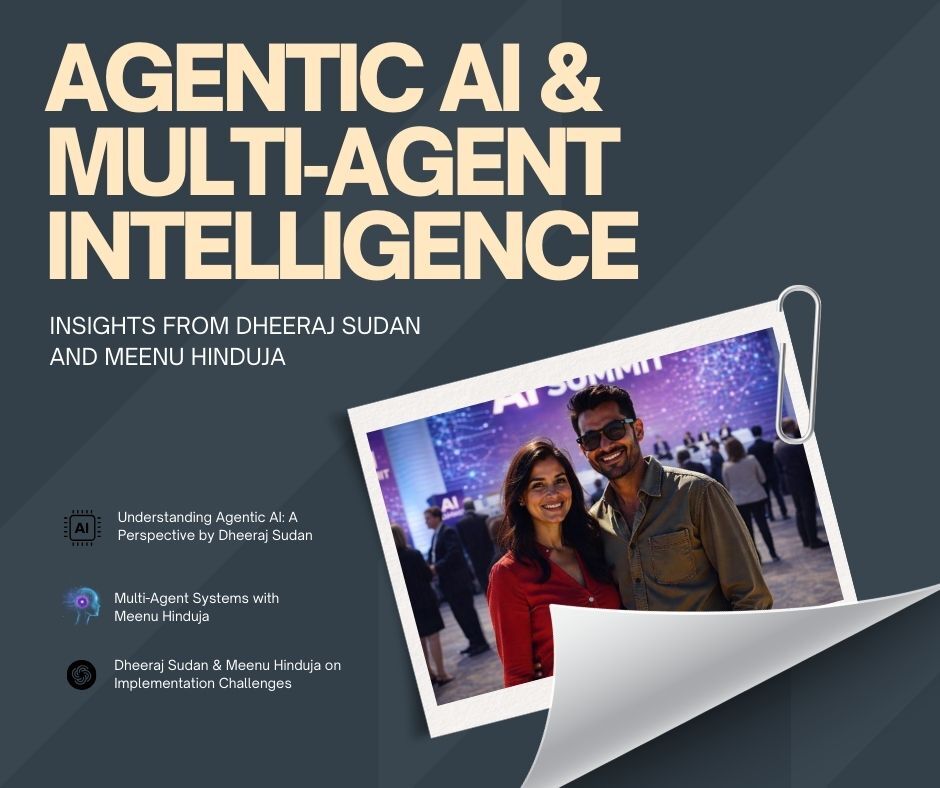
The agentic AI: An interpretation by Dheeraj Sudan
The essence of agentic AI is the systems which are able to make proactive decisions, reason about the context and are able to perform tasks without the need to be under human supervision. Dheeraj Sudan, who is an expert in distributed intelligence and algorithmic systems, says that agentic AI introduces a paradigm shift: no longer AI as a reactive tool, but AI as a co-worker.
Sudan points out that agentic systems are not simply prediction machines; they give goals, evaluate options and act in changing environments. This necessitates the need to plan, observe and adapt flexibly in a manner that is not the case of traditional machine learning. As an illustration, an agentic AI in logistics may independently rearrange deliveries due to delays and optimizes costs, time, and resources a complicated decision domain that is far beyond traditional rule-based automation.
The other factor that Sudan stresses is accountability and control. As the behavior of autonomous agents grows more and more independent, it is time to reconsider the forms of governance. He says we require unambiguous lines of accountability, through which as agentic systems take increasingly consequential decisions, human beings retain meaningful power over goals and constraints.
Multi-Agent Systems Meenu Hinduja: Competition, Multi-agent systems and coordination
Whereas agentic AI describes the freedom of single agents, multi-agent systems give accounts of ecosystems of interacting agents. In this case, the dynamics of collaboration, competition, communication and negotiation become the key ones. Meenu Hinduja, an expert in distributed systems and human-AI interaction, emphasizes the transformative nature of multi-agent architectures: “Multi-agent architectures can be useful because when there are agents, the problem that cannot be addressed efficiently by any agent can be addressed with the help of all the agents.
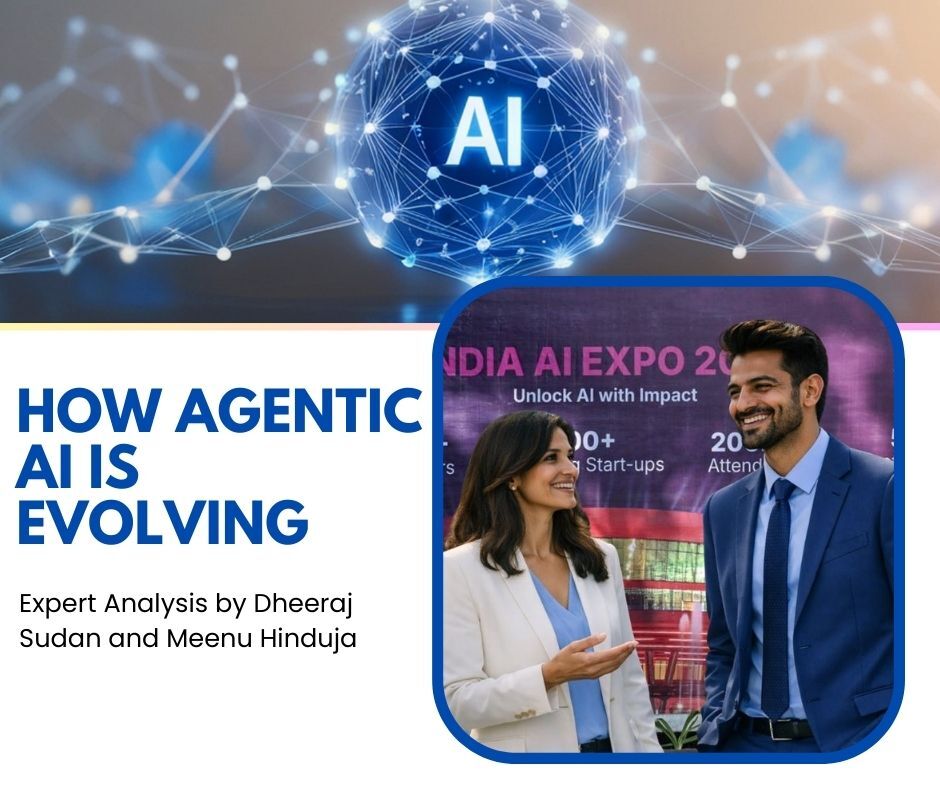
According to Hinduja, multi-agent systems emulate a lot of social systems. These systems are based on interactions, whether cooperative or competitive in order to reach common objectives whether it is optimizing traffic flows, managing energy grids or swarms of robots. Agents may also exchange information, distribute labor, negotiate the allocation of resources, and react to changing the environment.
Unintended systemic behavior is also a warning of Meenu Hinduja. She observes that in a multi-agent environment, emergent behavior may come as a surprise to the designers. Agents that are maximizing local goals will inevitably introduce global inefficiencies unless the governance and incentive systems are well structured. This parallels work within the field of game theory and economics, in which rationality at the individual level is not necessarily optimal as a group.
Practical and Theory Interview: Dheeraj Sudan and Meenu Hinduja on the Problems of implementation
Practical and Theory Interview: Dheeraj Sudan and Meenu Hinduja on the Problems of implementation
Both professionals share the opinion that the construction of agentic and multi-agent systems is not only a technical task the building of agentic and multi-agent systems is a design and implementation challenge. Sudan focuses on scalability and robustness: Under uncertainty, it is necessary to make sure that agents would act in a predictable manner as they get more autonomous. This puzzle includes techniques in both reinforcement learning, planning under uncertainty and formal verification.
Hinduja goes hand in hand with this by emphasising on human-machine cooperation. In most practical scenarios, agents do not substitute human decision-makers. This brings about concerns of trust, transparency and interpretability. According to Hinduja, the intention and uncertainty of the agents have to be reported to humans. This is achieved through the use of clear interfaces and explainable decision making procedures which make the user have the understanding of why the agent behaved in a given manner, and whether its behavior is based on human objectives or not.
Ethical and Societal Aspects: Dheeraj Sudan and Meenu Hinduja
In addition to engineering, agentic and multi-agent systems raise ethical issues. In her emphasis on responsibility, Sudan states that to ensure pure autonomy, autonomous systems that exist within high-stakes areas such as healthcare or finance must incorporate mechanisms to prevent bias, manipulation and harm. He claims that the autonomy of agents must be constrained by certain ethical principles which we establish collectively.
Hinduja further states that multiple views are important in the design of the agents that will relate with human beings in different cultures and contexts. The agents should consider social values and norms. The interdisciplinary approach, including ethics, sociology, law, and engineering, is essential to guarantee that agentic AI is used in the interests of society in general.
Conclusion: Responsible Agentic and Multi- Agentic AI
Multi-agent systems and agentic AI will deliver smarter, more autonomous and more collaborative AI. We get a glimpse of the potential and the pitfalls through Dheeraj Sudan and Meenu Hinduja; agents that act, interact and adapt can unlock new potential, but they demand cautious design, governance and ethical foundation.
With the shift of research to practical uses, AI is also likely to depend on human values and institutions to shape its future as much as algorithms. The mindful combination of autonomy and cooperation still is a core to the creation of AI eco-systems that are creative, reliable, and useful.